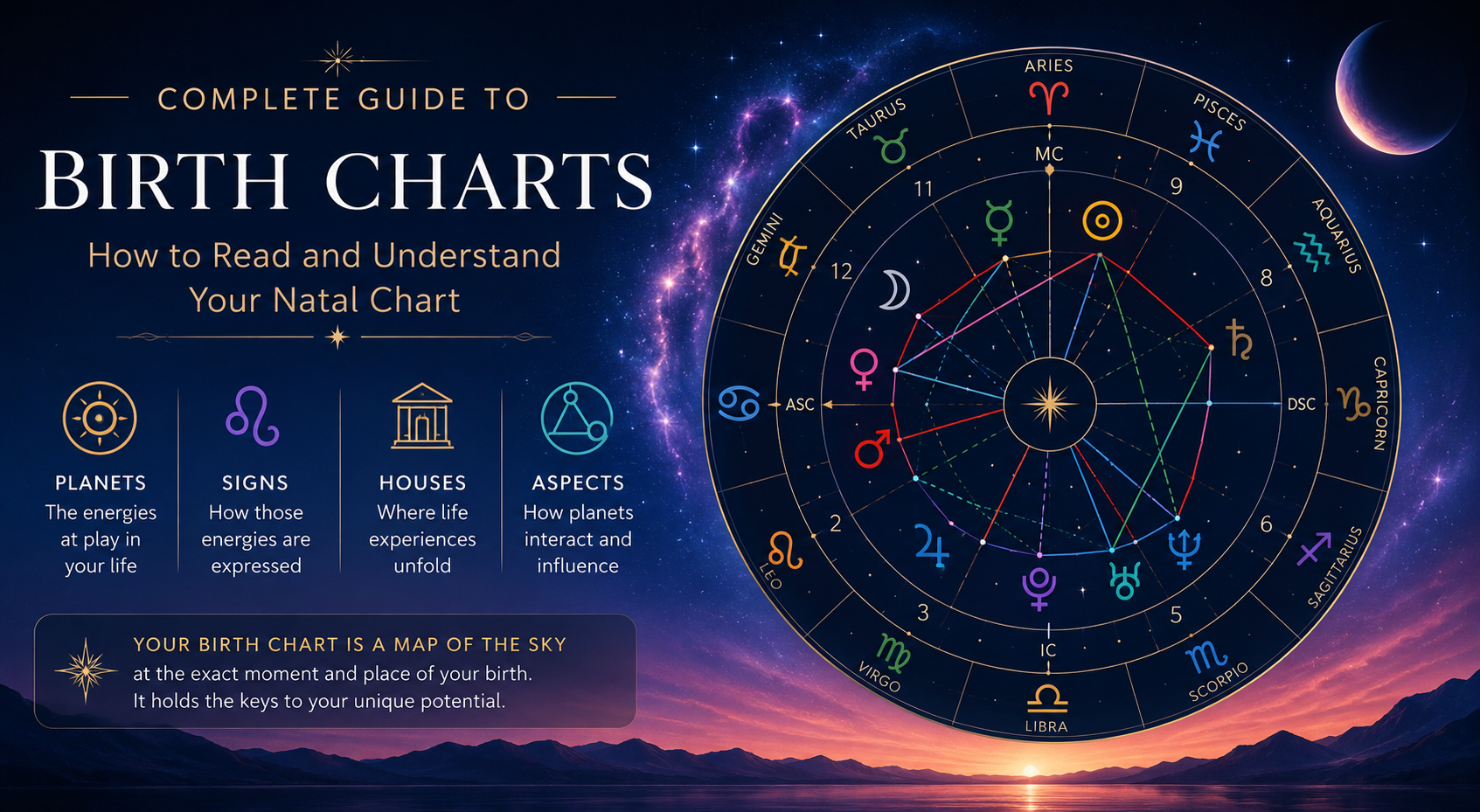
Complete Guide to Birth Charts: How to Read and Understand Your Natal Chart
Complete Guide to Birth Charts: How to Read and Understand Your Natal Chart
Updated for 2026 • Beginner-Friendly • Expert Guide
Introduction
Have you ever wondered why two people born under the same zodiac sign can have completely different personalities?
Why one Leo becomes a successful entrepreneur while another prefers a quiet creative life. Why one Cancer loves traveling while another rarely leaves home. Or why two people born on the same day experience entirely different life paths.
The answer lies in something much more detailed than your Sun sign.
It lies in your birth chart, also known as a natal chart.
A birth chart is one of the most fascinating tools in astrology. Rather than placing people into one of twelve zodiac signs, it creates a highly personalized map of the sky at the exact moment and location of your birth.
Think of it as your unique celestial fingerprint.
Every planet occupied a different position. Each rose above or set below the horizon at a specific moment. Together, these positions formed a symbolic blueprint that astrologers have studied for thousands of years to understand personality, relationships, talents, life cycles, challenges, and opportunities.
Today, millions of people use birth charts for self-discovery, career planning, relationship compatibility, relocation decisions, and personal growth.
Whether you are completely new to astrology or have already explored your natal chart, this guide will help you understand:
-
what a birth chart actually is;
-
how it is calculated;
-
why your birth time matters;
-
what the planets, signs, houses, and aspects represent;
-
how to begin interpreting your own chart step by step;
-
and how astrologers use birth charts in practice.
By the end of this guide, you'll understand not only what your chart contains, but how all its pieces work together.
What Is a Birth Chart?
A birth chart, also called a natal chart, is a map of the sky calculated for the exact date, time, and place of your birth.
Imagine pressing a cosmic "pause" button the moment you were born.
Where was the Sun?
Where was the Moon?
Which constellation was rising over the eastern horizon?
Which planets were directly overhead?
A birth chart records all of these positions and displays them as a circular diagram divided into twelve sections known as houses.
Unlike a daily horoscope based only on your Sun sign, a birth chart considers many interacting factors, including:
-
the positions of the planets;
-
the twelve zodiac signs;
-
the twelve astrological houses;
-
the angular relationships (aspects) between planets;
-
the Ascendant (Rising Sign);
-
the Midheaven;
-
and several additional mathematical points used in modern astrology.
Every chart is unique.
Even twins born only minutes apart can have subtle differences in house cusps or the position of fast-moving points, which is one reason astrologers often emphasize the importance of an accurate birth time.
Birth Chart vs Horoscope
One of the biggest misconceptions about astrology is that your zodiac sign tells the whole story.
In reality, your zodiac sign refers only to the position of the Sun at birth.
Your birth chart includes far more information.
For example:
-
Your Sun reflects your core identity and life purpose.
-
Your Moon symbolizes emotional needs and instinctive reactions.
-
Mercury describes how you think and communicate.
-
Venus relates to love, attraction, beauty, and values.
-
Mars represents motivation, energy, and how you take action.
-
The Ascendant (Rising Sign) influences how you approach the world and how others first perceive you.
Someone may identify strongly with their Sun sign while expressing many qualities associated with completely different signs through other placements.
For example, a Leo Sun with a Pisces Rising and Taurus Moon will likely present themselves very differently from a Leo Sun with Aries Rising and Sagittarius Moon.
This is why professional astrologers never interpret a person based solely on their Sun sign.
Why Every Birth Chart Is Unique
There are approximately 360 degrees in the zodiac.
Ten major planets.
Twelve houses.
Numerous aspects.
Additional points such as the Lunar Nodes, Chiron, the Part of Fortune, Black Moon Lilith, and the Vertex.
The number of possible chart combinations is enormous.
This complexity is one reason astrology continues to intrigue both beginners and experienced practitioners.
A birth chart is not simply a personality label.
It is a symbolic model showing how different psychological tendencies, life themes, strengths, and challenges interact.
Professional astrologers don't examine one placement in isolation.
Instead, they look for patterns.
For example:
-
Which element dominates the chart?
-
Which planets are strongest?
-
Which houses receive the greatest emphasis?
-
Which planetary aspects repeat similar themes?
-
Where are the greatest opportunities for growth?
-
Which life areas are likely to become particularly important?
The answers emerge from the chart as a whole.
Is a Birth Chart a Prediction of Your Future?
One of the most common questions people ask is:
"Does my birth chart determine my destiny?"
The short answer is:
No.
A birth chart is generally understood by astrologers as a symbolic framework rather than a fixed script.
It does not remove free will or guarantee specific events.
Instead, it highlights recurring themes, natural strengths, potential challenges, and periods when certain topics may become more significant.
Think of it like a map rather than a set of instructions.
A map can show mountains, rivers, and possible routes.
It cannot decide which path you choose.
Different schools of astrology interpret this relationship differently. Some place greater emphasis on psychological development, while others focus more on timing techniques or life events. Throughout this guide, we will explain the major approaches and where they overlap.
Why Birth Time Matters
Many beginners assume that knowing their birthday is enough.
In reality, the exact birth time is one of the most important pieces of information in astrology.
A difference of just a few minutes can sometimes change:
-
the Rising Sign;
-
the house positions of planets;
-
the Midheaven;
-
important angles used for interpretation.
The Ascendant changes approximately every two hours, meaning an inaccurate birth time can significantly alter the structure of the chart.
If you don't know your birth time, don't worry.
Many astrologers use a process called birth time rectification, where major life events are compared with astrological timing techniques to estimate the most likely birth time. We'll cover this process later in the guide.
A Birth Chart Is More Than Personality
Many people first discover astrology through personality descriptions.
While personality is certainly part of natal astrology, experienced astrologers often use birth charts to explore much broader questions, including:
-
career direction;
-
relationships;
-
family dynamics;
-
education;
-
relocation;
-
financial patterns;
-
creativity;
-
health tendencies;
-
important life cycles;
-
periods of opportunity and challenge.
Different branches of astrology specialize in different topics, but they all begin with the natal chart.
It serves as the foundation for nearly every advanced astrological technique, including:
-
transits;
-
progressions;
-
solar returns;
-
synastry (relationship astrology);
-
electional astrology;
-
relocation astrology;
-
astrocartography.
Without understanding the birth chart, these techniques are difficult to interpret correctly.
The Four Building Blocks of Every Birth Chart
Every natal chart, regardless of the astrological tradition, is built upon four fundamental components.
Understanding these four elements is the key to reading any chart.
1. The Planets — What Is Happening?
The planets represent different psychological functions and areas of human experience.
For example:
-
the Sun symbolizes identity;
-
the Moon reflects emotions;
-
Mercury governs thinking and communication;
-
Venus relates to love and values;
-
Mars represents action and motivation.
Think of the planets as the actors in a play.
2. The Zodiac Signs — How Is It Expressed?
The zodiac signs describe how planetary energy is expressed.
Mars in Aries behaves differently from Mars in Libra.
Venus in Taurus values stability, while Venus in Aquarius seeks freedom and originality.
The sign gives each planetary function its unique style and expression.
Think of the zodiac sign as the actor's personality or costume.
3. The Houses — Where Does It Happen?
The twelve houses describe the areas of life where planetary energies are most likely to manifest.
For example:
-
career;
-
relationships;
-
finances;
-
family;
-
education;
-
travel;
-
creativity;
-
spirituality.
Think of the houses as the stage where the actors perform.
4. The Aspects — How Do They Interact?
Aspects describe the angular relationships between planets.
Some indicate harmony and cooperation.
Others suggest tension, growth, challenge, or transformation.
They explain why certain parts of the personality work together easily while others require conscious development.
Think of aspects as the dialogue between the actors.
Together, these four components create an integrated symbolic system.
Understanding how they interact—rather than interpreting them one by one—is what transforms a list of placements into a meaningful birth chart interpretation.
What's Next?
Now that you understand what a birth chart is and why it is much more than a zodiac sign, the next step is to learn how it is actually calculated.
In the following section, we'll explore:
-
why your exact birthplace matters;
-
how astrologers calculate planetary positions;
-
why the Earth's rotation changes the houses;
-
what house systems are;
-
and why two people born on the same day can still have very different charts.
This is where astrology moves from simple horoscopes to a precise symbolic map unique to every individual.
.jpg)
.jpg)
.jpg)
.jpg)
.jpg)
.jpg)